Shop Sets
Set Collection



It’s not hard to notice that in today’s high-quality knife market, Japanese knives often stand out with much higher price tags than those from other countries. You can easily come across Japanese knives priced at several hundred dollars, even reaching the thousands.
Professionals and home cooks worldwide favor these knives despite their high cost. So, let’s explore the reasons behind this pricing and see whether they’re worth it!
Artisans make Japanese knives with great care, using special materials that keep them sharp, strong, and beautiful for a long time. The blade, the most important part of a knife, usually consists of high-carbon steel, stainless steel, or sometimes ceramic. High-carbon steel blades deliver exceptional sharpness and allow cooks to sharpen them easily, but they require quick cleaning and drying to prevent rust.
Stainless steel resists rust well and offers excellent performance for everyday cooking, although it often requires more frequent sharpening. Artisans forge some very fine knives from Damascus steel, creating blades with beautiful patterns and an ideal balance of strength and sharpness.

The handle is also an essential part of a Japanese knife. Traditional handles are often made of wood, like magnolia or walnut, because they feel warm in your hand and are easy to hold. These wooden handles are light, making the whole knife easier to use for a long time.
In more modern styles, you might find plastic or resin handles suitable for kitchens that get very busy whether wooden or synthetic. Japanese knife handles are always designed to feel natural and comfortable when chopping, slicing, or cutting.
Are you looking for the best knives and knife related accessories? Check out ZAKU! ZAKU has authentic knives handmade in Japan for all of your culinary needs!

Making a Japanese knife is not something that happens in just one day. It is a long and careful journey, full of patience and skill. Depending on the knife, the process can take several days to more than a month.

For example, in places like Takefu Knife Village, many knife makers spend three full days forging, heating, pounding, and shaping the steel. Then, there are more steps: cooling the blade in special furnaces, sharpening it just right, and attaching a perfectly made handle.
In some knife studios, like Miyabi, the entire process can take up to 42 days for a single knife. That’s because each step is done by hand, and each artisan focuses on just one part to ensure great precision.
Japanese knives are created by expert artisans who have trained for many years, sometimes even decades. These makers don’t just follow steps; they deeply understand the heart of the steel. They know when to heat it, shape it, and cool it down, all by feel and experience.

Many have learned these skills from their families or teachers, passed down through generations. Every detail, from the blade’s curve to the final edge, is carefully shaped. This deep knowledge and attention make each knife one of a kind, and that is a big reason why Japanese knives cost more.
Many makers of Japanese knives still use techniques from the time of the samurai. Instead of relying on machines in large factories, craftsmen carefully forge the blade over fire, shape it with skilled strikes, and cool it at the perfect moment to reveal its true strength.
Artisans complete each step slowly and carefully by hand. They sometimes fold and layer the steel to create blades that combine strength with beauty. These steps take a long time but help make the knife sharper, stronger, and more balanced.

Another reason Japanese knives are expensive is that almost everything is done by hand. Real people work on each part, from shaping the blade to sharpening it and even attaching the wooden handle.
They use their eyes, hands, and hearts to check and perfect every tiny detail. Machines might be faster, but they cannot feel the steel or understand its spirit as a person can. This careful handwork takes longer, but it helps each knife become truly special.
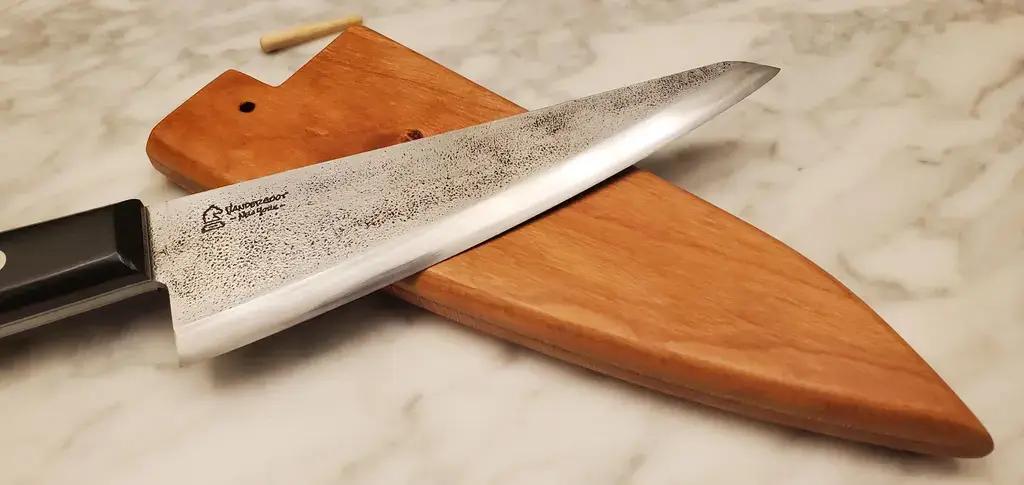
If you are wondering when a Japanese knife is expensive, look for quiet signs: a gentle shine on the blade, a wave-like pattern from layered steel, a handle that feels just right, and an edge that stays sharp. More than that, it feels balanced — light but strong, precise yet effortless.

High-end Japanese knives are pieces of tradition, shaped by skilled hands and passed down through generations. While price can hint at quality, the real value lies in how it feels in your hand and how it moves when you cook.
Have you ever held a knife that felt special when you picked it up? What do you think makes a knife worth the price? Let us know in the comments.
©2026 ZAKU Knife - All rights reserved
SUBSCRIBE TO OUR NEWSLETTER
Bet the first to know about our latest and exclusive deals